Explore Our Expert Services
Weʼre not your average construction materials supplier, from takeoff to delivery, we can do as much as you need!
Cement, TMT Bar, Sand, Bricks, Coarse Aggregate
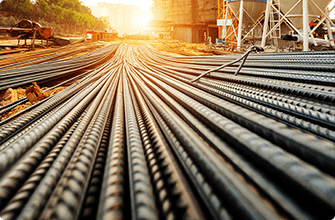
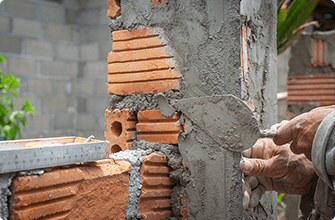
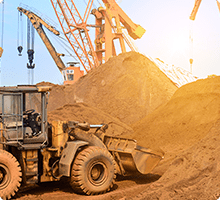
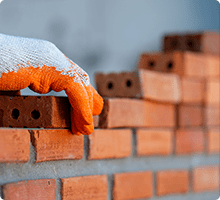
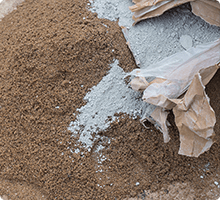
Know More About TMT Bar
High Strength Thermo Mechanically Treated Bars with low carbon steel. TMT Bars are the main component to provide strength to your structure. TMT Bar bonds with RCC and hold the structure. It comes in Different Grades as per Indian Standards (IS) such as:
Fe 415 | Fe 415D | Fe 500 | Fe 500D | Fe 550 | Fe 550D | Fe 600
‘D’ denotes elongation. Fe 500D has the perfect balance of Strength & Flexibility. That is why it is most recommended for all type of construction purposes. It is essential to use 55D grade TMT Bar of integrated steel plant. (For list of integrated steel plant you can check yearly steel report on ministry of steel official website.)
Know More About Cement
Construction materials such as sand, bricks, Steel Bars bind with cement. Cement is the binder in construction. Cement comes in different grades as per the Indian Standards (IS) such as:
33 Grade Cement
33 grade cement has composite strength of 33N/mm2 after 28 days of curing.
33 Grade Cement is used for general construction work and it is suitable for lower concrete grade such as M15 or M20. Nowadays 33 Grade is hardly manufactured because higher grades are most acceptable ones in construction.
43 Grade Cement
43 grade cement has composite strength of 43N/mm2 after 28 days of curing.
43 Grade Cement is used for plastering, concrete work, precast items such as tiles, blocks etc. It is most suitable for concrete grade mix upto M30.
53 Grade Cement
53 grade cement has composite strength of 53N/mm2 after 28 days of curing.
53 Grade Cement is suitable to use on or over concrete grade mix of M25.
Know More About Sand
Different types of sands are available to the market for construction purposes. Sand is basically the particles of broken rock. Sand is an important material for construction because it provides bulk, strength and other properties to the concrete. Different types of sands are:
River Sand
Whitish grey in color and rounded particles sands that are generally gathered from the bank of the river. River Sands are highly effective for plastering and other construction purposes.
Coarse Sand/Pit Sand
Coarse Sand is procured from deep pits where the supply is abundant. In Course Sand the grains are sharp, yellow-reddish in color, salt free. It is commonly used in Concreting.
M Sand
M Sand is used as a substitute of River Sand. It is manufactured by following the guideline of Indian Standards codes (IS). M Sand is manufactured by crushing granite/basalt rock. It is also known as Artificial Sand or Stone Sand.
Know More About Bricks
Brick is an important material in construction mostly it is manufactured from clay and rectangular in shape. Different types of Bricks are:
Unburnt Bricks
Bricks that are sun dried are known as Unburnt Bricks. These bricks are mostly used for temporary structures. These types of bricks are less durable, less water resistant and less fire resistant therefore it cannot be used for permanent structures.
Burnt Bricks
Burnt Clay Bricks are sub categorized into four types.
First Class Bricks
Standard Size, Sharp Edge, Smooth Surface bricks that are highly acceptable for load bearing and other masonry construction purposes.
Second Class Bricks
Bricks that are moulded by ground moulding process is known as Second Class Bricks. Shapes of the bricks are irregular for ground moulding.
Third Class Bricks
Poor quality bricks that has rough surface, unfair edges mostly used for temporary structures.
Fourth Class Bricks
Very poor quality bricks that can break easily are known as fourth class bricks. These bricks are not used for any structures it is been used as course aggregate in most cases.
Know More About Coarse Aggregate
Aggregate in construction is used for mixing with cement. The aggregate gives stability, volume to the finished structure. Coarse aggregate particles are either 0.19 inch or more in size. It acts as additives to concrete mixes.
Apart from these 5 important construction material there are others such as Wood, Metal, Glass, Foam, Tarpaulin and the list is endless. In construction endless number of things is needed but, these are the Most Important Construction Material with which we cannot compromise on quality.
Know More About Construction Material
TMT is a series of unique thermomechanical processes to make durable steel rods using modern metallurgy science.
TMT stands for Thermo Mechanical Treatment
TMT holds an essential status in construction and civil establishments.
TMT bars do not carry surface deformities and give better strength to structures.
TMT bars can bear a sudden stress load. Thus, making them an excellent choice to use in seismic zones like 3, 4 and 5.
TMT carries great ductile strength- Which gives a free hand to build unique design structures.
TMT process makes them corrosion-resistant thus are used in constructions like dams, bridges or canals. (Frequent contact with water)
Due to numerous properties of strength, they give longevity to the structures in future.
TMT plays a vital role in reinforcing the concrete to avoid cracks.
TMT bars are fire resistant and can resist fire to up to 1000 degree Celsius.
TMT bars are cost-effective and feasible when compared to other steel bars.
Simply for enhancing the better holding and anchoring properties of the structure.
Cement or concrete has a tremendous compressive property but low tensile and ductility. This is why cement is reinforced with TMT bars, as it creates better bondage and avoids slippage.
This reinforcement helps to avoid cracks within concrete/ cement.
The temperature change in the environment helps them expand and contract freely while undergoing different compression, tension and shear forces.
- Standard quality of the TMT bars- as per the international standard. BIS 1786-2008
- The right type of grade
- Flexibility and bendability
- Fire-resistant property
- Corrosion-resistant
- Earthquake resistant
Traditionally there are 9 grades of TMTs available.
However, these days most popularly used and reliable is Fe-550D grade TMT bars
Some of these are Fe - 415, Fe- 500, Fe- 550D & Fe-600
- TMT bars must be ISI certified and must carry an ISI mark on the product
- Brand/manufacturer name should be engraved with the grade on each TMT bar.
- Manufacturers must provide you with a chemical and physical test authenticity report.
- The standard length of each TMT rod should be 12m
- Ensure the TMT bars adhere as per IS 1786:2008
- The diameter of each bar should be the same and consistent
- Product of Integrated Steel plant are the best and companies can be verified on ministry of steel website. Check Annual Report at government website.
Generally, OPC 53 Grade cement is suitable for all RCC structures like footing, column, beam, and slabs, where ever initial and ultimate strength is the major structural requirement.
PPC and PSC cement are recommended for general construction works and strongly recommended for Masonry, Plaster, and Tiling works as initial strength not being a prime factor of performance in this application.
The use of PPC not only reduces the cost of construction but also helps in improving the quality of the structure.
Portland cement is composed of calcium silicates and aluminate and aluminum ferrite. It is obtained by blending predetermined proportions limestone clay and other minerals in small quantities which are pulverized and heated at high temperatures of around 1500 degree centigrade to produce clinker. The clinker is then ground with small quantities of gypsum to produce a fine powder called Ordinary Portland Cement (OPC). When mixed with water, sand, and stone, it combines slowly with water to form a hard mass called concrete.
Call our helpline or email us and we will get in touch with you.
PPC is manufactured either by inter-grinding, Portland cement clinker, fly ash and gypsum to the required fineness or by blending ground OPC with fine fly ash. Fly ash is a by-product in coal-based thermal plants.
Grades 53, 43 and 33 indicate the compressive strength of cement in Newtons for one mm2 area i.e., 53 grade means a compressive strength of 53 N/mm2 attained after a curing period of 28 days. Similarly, 43 and 33 grades may be defined.
There are different types of cement, the most common cement that is supplied are:
- Ordinary Portland Cement (OPC)
- PPortland Slag Cement (PSC)
- Portland Pozzolana Cement. (PPC)
The OPC 53 grade cement and PPC cement is usually preferred for concrete purposes.
The OPC 43-grade cement is preferred for plastering.
Mainly there are 4 grades they are the OPC 43 grade, OPC 53 grade, and PPC.
The minimum order quantity is 50 bags.
The minimum curing period required is 15 days.
In the light of the foregoing, it is incur bent on the consumer to do a few basic checks to make sure the quality of the cement is of good quality.
BIS monogram and website are printed on the bag.
Check the year of manufacture of the cement, the first week starts from 1 January of the year.
Check if the company's packing is intact.
Check if the cement is of fresh stock.
We'd Love to Hear from You
Please feel free to get in touch using the form.
We’d love to hear your thoughts and answer any questions you may have!
